
Chord Glide
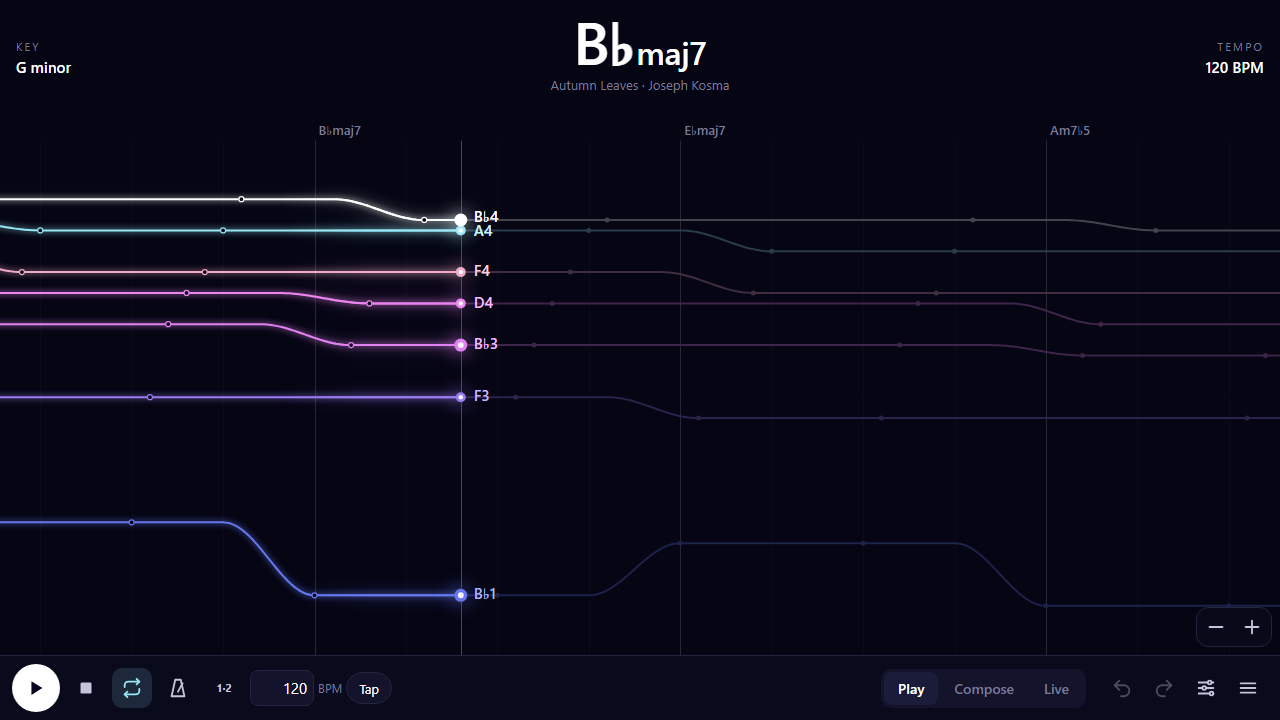
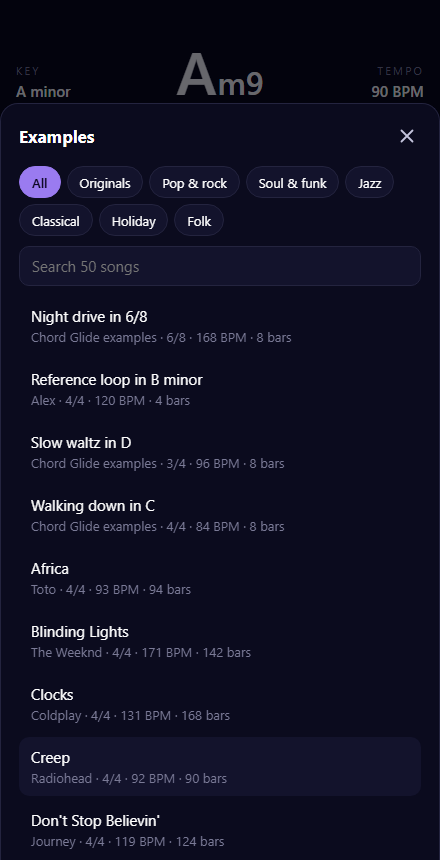
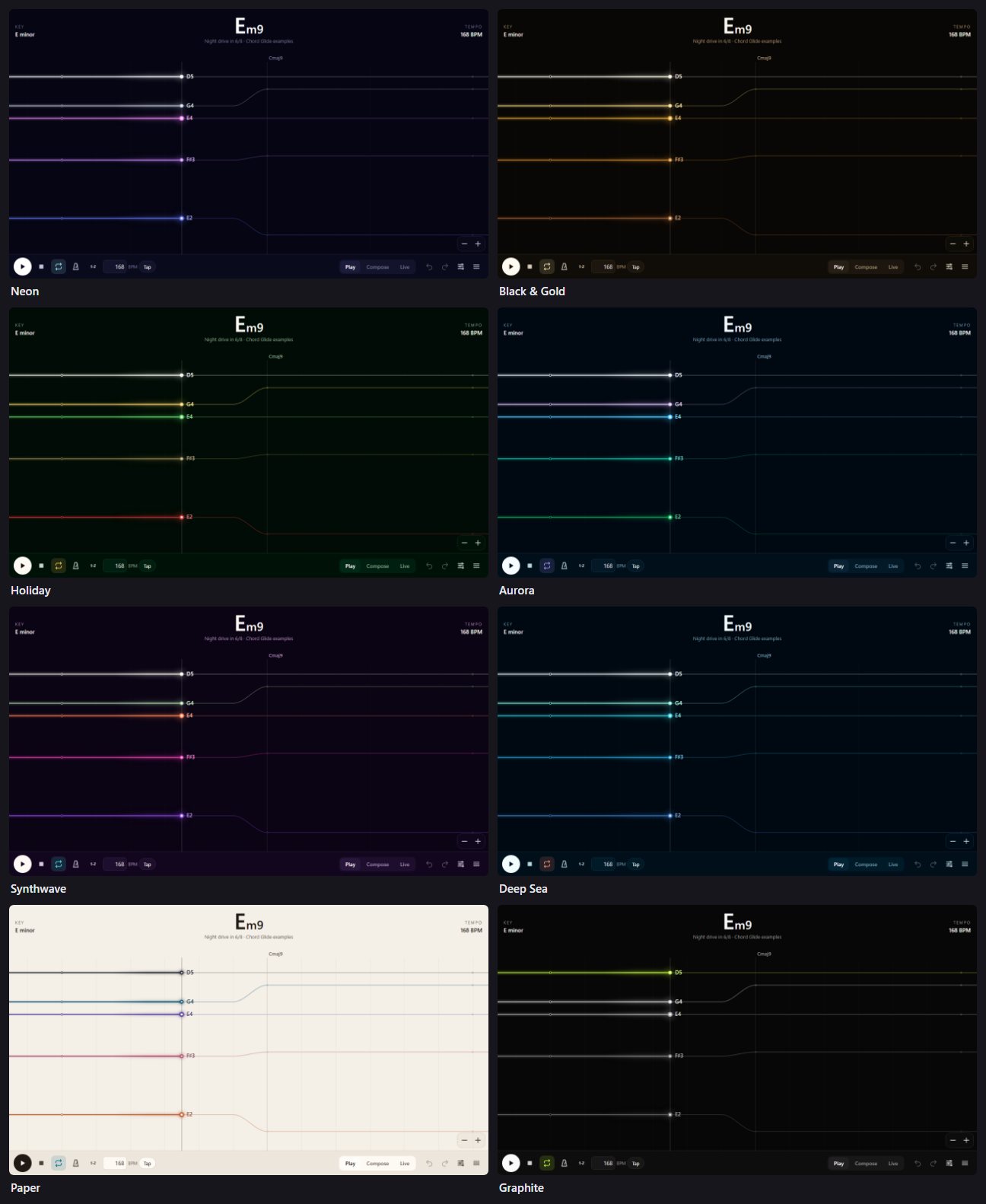
Chord Glide turns a chord progression into a sustained synth pad, with every voice gliding into the next chord, and draws each voice as a glowing line moving through pitch over time. It's a static web app with no server or accounts, 50 example songs, and a live performance mode. Songs are small JSON files you can save, share as a link, or have an AI assistant write.
- My role
- Solo project: product spec, design, and development
- Topics
- React · TypeScript · Web Audio · Canvas · Music theory
The Idea
A lot of what makes a chord progression sound good is how the individual notes move from one chord to the next, and that's hard to see in a list of chord symbols. I wanted a tool that makes it visible and audible at once: write the chords, hear them as a smooth pad, and watch each voice glide into place.
What I Built
Three modes: Play to listen and scrub; Compose to edit chords, lengths, slash basses, and any voice of a voicing by hand; and Live, which turns a song's chords into pads you tap in time, landing each change on the next downbeat and recording the take. It ships with 50 full-length example songs across pop, rock, soul, jazz, classical, holiday, and folk, plus four synth presets, eight color themes, a guided first-run tour, WAV export, and offline, installable support.
Songs are small JSON files with a published JSON Schema. The app can copy a prompt for an AI assistant to write a song, and if pasted JSON has problems, it lists every one with its path, ready to send back to the assistant.
How It Works
One pure function, compile(song) → timeline, turns a song into holds, glides, strike times, and voicings, all measured in beats. The Web Audio scheduler and the canvas renderer both sample that same timeline at the beat the audio clock reports, so sound and picture can't drift apart.
It's built with React, TypeScript, Vite, Zustand, and Zod. The music theory, song model, timeline, and theme layers use no browser APIs and are tested in Node, and lint rules keep the audio and rendering code independent of each other. It deploys as static files on Cloudflare.
Challenges & Decisions
The core of the app is the voice-leading solver that picks a smooth voicing for each chord. To keep it fast, the solver prunes its search with a lower bound that can't change the result, and a test checks it against a line-for-line port of the original prototype on about 2,400 random cases.
Another rule: voices never visibly cross. Glides that move together on one curve can't cross, but a rolled strike staggers them, so a lower voice could pass a neighbor that hasn't moved yet. For those changes only, the voices take the sorted pitches at every instant, so the lines touch and part instead of crossing.
What I Learned
Writing a detailed spec first, with the product rules spelled out (the whole chord changes together, the change takes the last beat, shared notes carry over), made the build much easier to verify. An independent audit against the spec caught deviations before release, and the end-to-end tests map back to its acceptance criteria.
Current State
Feature-complete for a first version, with CI running type checks, lint, unit tests, a deploy dry run, and end-to-end tests in Chromium and WebKit. Still to confirm on real devices: sound with an iPhone's silent switch on, and frame rate on actual phones. It holds 60 fps with seven voices under 4× CPU throttling.
Screenshots
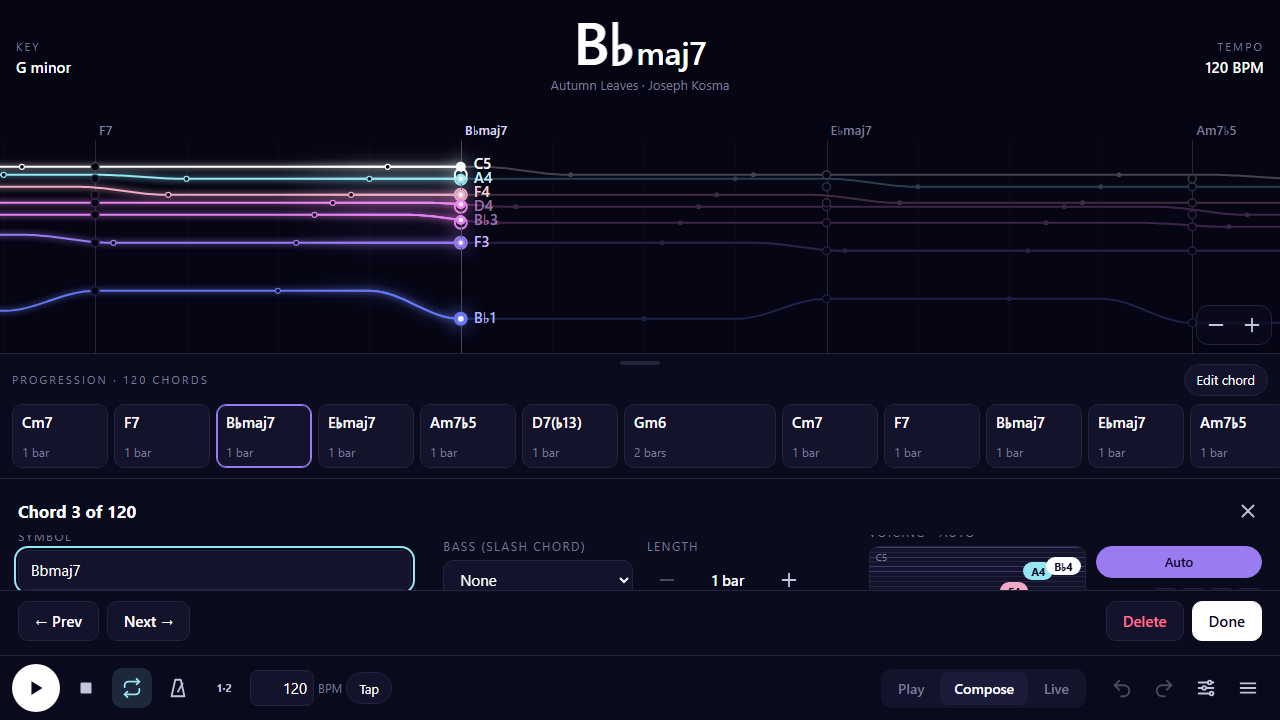 (open full size in a new tab)
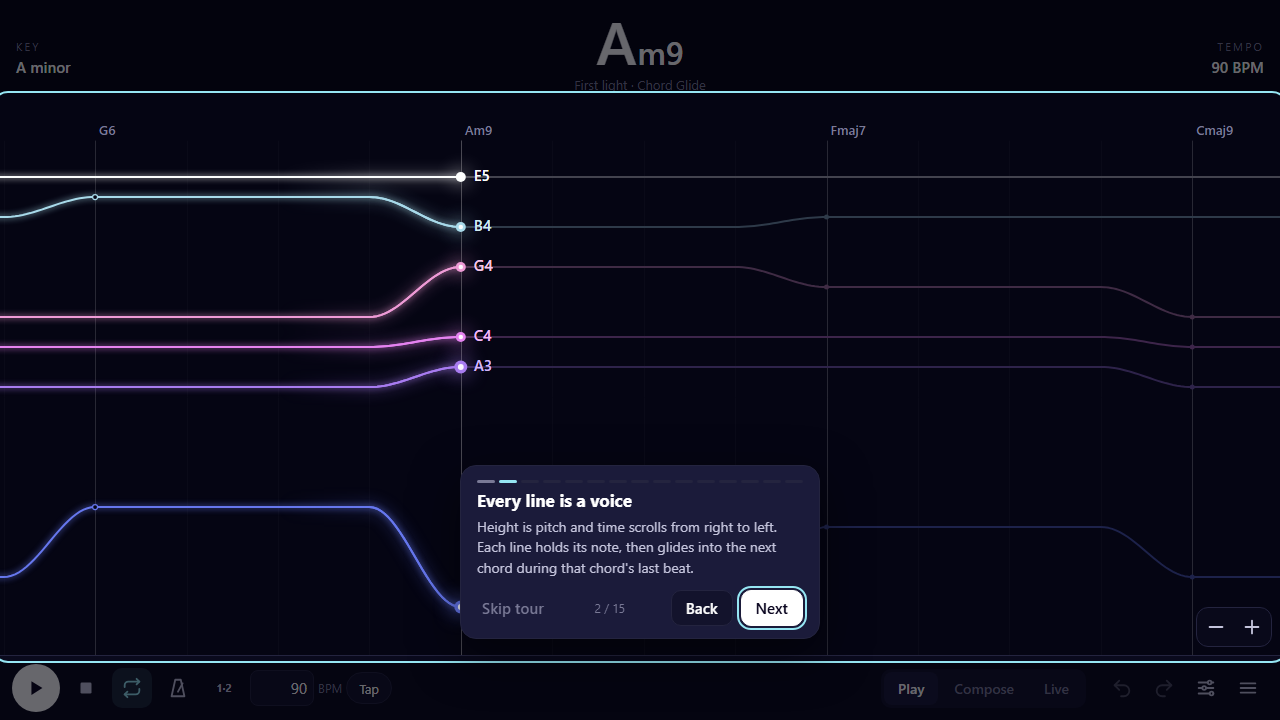 (open full size in a new tab)
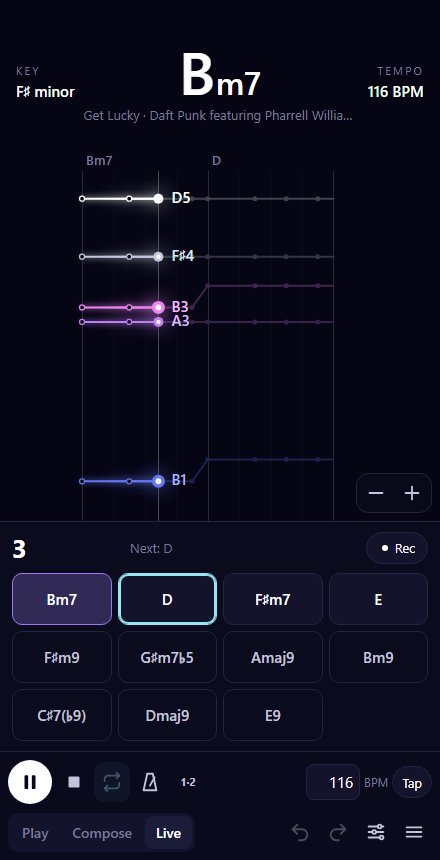 (open full size in a new tab)
 (open full size in a new tab)
 (open full size in a new tab)